
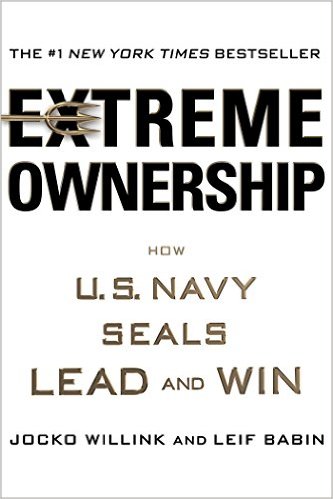
I recently completed the book Extreme Ownership written by Jocko Willink and Leif Babin. This is one of the best books I have read to date on leading people in complex situations.
Jocko is a retired Navy Seal. He was the commander of SEAL Team Three’s Task Unit Bruiser during the battle of Ramadi, he orchestrated SEAL operations that helped the “Ready First” Brigade of the US Army’s First Armored Division bring stability to the violent, war-torn city. Task Unit Bruiser became the most highly decorated Special Operations Unit of the Iraq War. Jocko returned from Iraq to serve as Officer-in-Charge of training for all West Coast SEAL Teams. There, he spearheaded the development of leadership training and personally instructed and mentored the next generation of SEAL leaders who have continued to perform with great success on the battlefield.
Leif Babin is a former Navy SEAL officer, as a platoon commander in SEAL Team Three’s Task Unit Bruiser, he planned and led major combat operations in the Battle of Ramadi that helped the “Ready First” Brigade of the US Army’s 1st Armored Division bring stability to the violent, war-torn city. Task Unit Bruiser became the most highly decorated special operations unit of the Iraq War. Leif returned from combat as the primary leadership instructor for all officers graduating from the SEAL training pipeline. There, he reshaped SEAL leadership training to better prepare SEAL officers for the immense challenges of combat. During his last tour, Leif served as Operations Officer and Executive Officer at a SEAL Team where he again deployed to Iraq with a Special Operations Task Force.
(The bios above were copied from their web page, Echelon Front)
This book takes their experiences leading a group of professional soldiers and managing their missions in a dangerous, fluid, multi-operational task force and applying those situations to a business environment. They do a great job of explaining their mission and the complexities it involved and then applying that to business situations that mirror those specific challenges. Their experience in Ramadi pushed the envelope in what could be expected of a leader and this book details how to apply those leadership principles to any environment. The lessons are easy to understand and implement. Ultimately learning that leadership at every level is the most important factor as to whether a team is successful or not.
Overall the book is a pretty quick read with 285 pages and 12 chapters covering topics like: No Bad Teams Only Bad Leaders, Believe, Prioritize and Execute, Plan, Leading Up and Down the Chain of Command. Each of these chapters begins with a great analysis of an actual situation that occurred during their management of SEAL Team Three and then summarizes how this principle is applied to business. The strike commentaries are so compelling that these alone would make the book a good read but its real world application is truly a bonus to that piece of the book. When I try to create the parallel between what we deal with in the management of a large complex construction projects, changing conditions, personnel, a litany of stakeholders up and down the ladder, safety, weather, and detailed plans that always seem in flux, I get a glimpse of the challenges to some small degree their teams had to overcome in a much costiler environment.
In a nut shell this book talks about ownership of the situation or the problem, regardless of who or why, big or small if I have been asked to lead it there is a expectation it is mine to own. This book would be a great learning tool to either newcomers or experienced industry vets and should become part of your training routine, in an industry of problems and excuses I am looking for my teams to take Extreme Ownership of their environment and lead their way to success.
If you are interested in purchasing this book I have attached the link below:
EXTREME OWNERSHIP
J. Hughes
Project Superintendent
 Construction Daily