
8 Wastes in Construction

Over the last few weeks we have covered a number of topics related to Lean Construction Principles, the Daily Huddle, Pull Planning, Gemba Walks and the 5 S’s. Each of these play an important role in your Lean Tool Box. Today we are going to cover the 8 Wastes and how to help reduce their impact on your Project.

Over the years manufacturing has seen drastic improvement in the production of goods and this has lead to great improvements with in this industry. This same improvement has not been recognized within the construction industry. Those of us practicing Lean Construction are looking to change that, but to make this happen we must first identify the 8 Wastes. Traditionally this is associated with the amount of waste identified on the project. This can also be said as anything that is identified that does not add value to your project.

The 8 Wastes consist of Defects, Over Production, Waiting, Non-Utilized Talent, Transportation, Inventory, Motion and Excess. Each of these have an impact on how your job runs and by being able to recognize their impact you will continue to sharpen your Lean Tools.
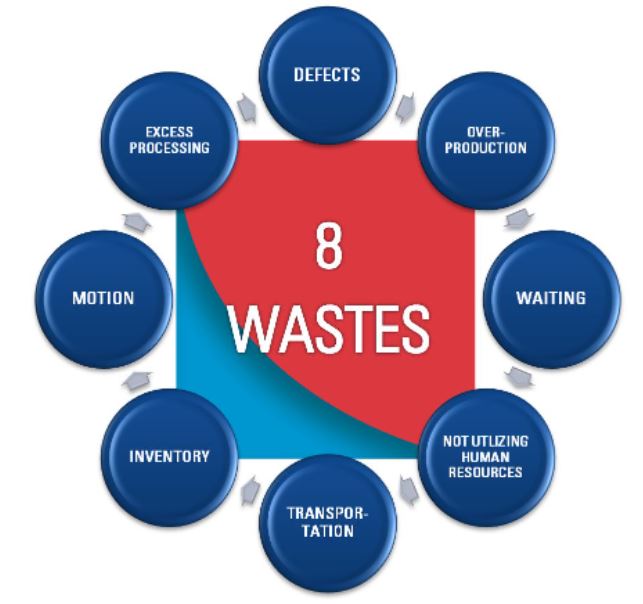
  1. Defects are anything that has been damaged and repaired, replaced or re-done. This includes materials that appear on a Punch List. This results in the re-work or scrapping of the work.
  2. Over production is building to soon, delivery of materials to the project before it is ready to be installed which causes double handling. And may lend to defects if the material is damaged while waiting to be installed. Just in time delivery has materials arriving on the project when it is ready to be installed.
  3. Waiting corresponds to crews waiting on materials or the completion of activities that need to be done prior to another activity happening. Like an RFI being answered. Project equipment like Cranes not being fully utilized is also an example of waiting waste. What we are striving for is continuous flow in people, equipment or materials.
  4. Non-Utilized Talent is failing to make use of the skills or knowledge of your team. A decentralized command structure allows for the craftsmen responsible for producing the work to be more engaged in the process and use their knowledge to improve production.
  5. Transportation is the unnecessary movement of materials or equipment. This often occurs when materials are delivered to a project too soon and need to be moved from one location to another to facilitate work taking place in that area.
  6. Inventory is the over production of materials or equipment resulting in excess. This material is then needed to be stored in the yard or shipped back to the manufacturing facility where it was produced.
  7. Motion waste is identified as the extra steps the craftsmen will take to complete their work. Such as time searching for the correct material or the tools necessary to complete the job. This can also be identified as any lifting, reaching, bending and the excess movement necessary to install the materials.
  8. Excess is the over processing materials in the value chain which may cause double handling or transporting material back to the shop or manufacturer, this often creates storage costs.

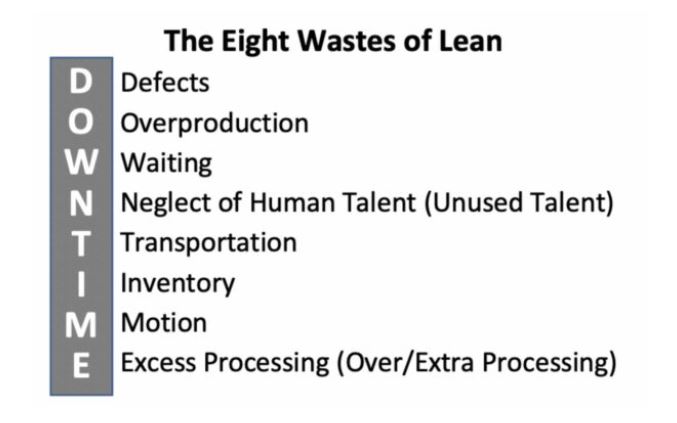
These wastes are often identified with the acronym “DOWNTIME”
So how does one go about identifying these wastes? It can often be done with a Gemba walk, by having discussions with the suppliers/manufacturers or employees on the project. Once you understand where one of the 8 wastes is originating you can work to reduce or eliminate its impact on your project.

There is a great book written by Paul Akers ” 2 Second Lean” which goes into his company’s Lean Journey. It covers in detail their journey to reduce waste and their process for continual improvement. This book is readily available on their website and has been made available as a free download.

So the question is posed, how will you identify waste on your project, what will be done to help eliminate its effect and how will this effect project planning in the future?

For the last few weeks I have posted a number of articles related to Lean and my own Lean journey I hope these have provided you some additional tools for you and your team to use. If you are looking to see some of my past articles or would like to see me cover something else related to Lean please feel free to reach out to me here or on my blog www.construction-daily.com

J. Hughes

Superintendent
Pull Planning for Success

Pull Planning like most successful activities in construction requires a significant amount of coordination and work to to achieve great results. How will you coordinate and develop a successful pull plan meeting and what needs to be coordinated in advance to ensure the outcome you are looking to achieve?

To manage an effective pull planning exercise you will need to establish what portion of the construction schedule you are planning on pulling and identify who will be part of the meeting. It is imperative to have the individuals responsible for executing the work present. You are looking for the Project Managers and Superintendents with your team and your trade partners involved in this specific work phase working together. Additionally the Design Architects, Schedulers and Quality Control Representatives could be present as well.

In preparation for the meeting you will need to identify and distribute to the participates the area of work you plan on pulling. They will need to be very familiar with this phase, available materials and any outstanding issues that may not have been resolved. Each team will need to come to the meeting prepared to be completely honest in the work they can perform and the amount of time it will take to accomplish it making sure not to add any fluff to their durations. They will also need to speak to what will need to be accomplished prior to their work starting.

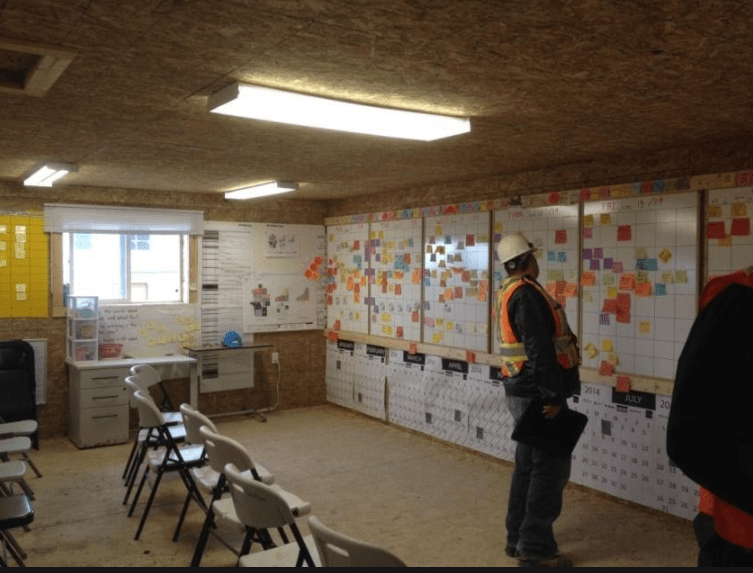
You will need to coordinate the date a few weeks in advance to ensure everyone needed is available for the exercise. And you will need to have a space large enough to accommodate the activity and plenty room on a wall or table to be able to manage the 6-8 weeks a pull plan is generally expected to review. In our case we set up a long sheet of plotter paper with the weeks identified on the top of the sheet. You will establish the completion milestone you are looking to hit. It is helpful to have a few key interim milestones shown as well, but don’t be to concerned with these yet, the pull planning team will help identify other key milestones as well.

Generally each trade is identified by a specific color post it or colored magnet. To save time you can send these to the contractors ahead of time and they can preload their “stickies” with a task name, duration and the activity they believe needs to be complete prior to them starting their work.

On the day of the exercise plan to have on hand the project contract documents, calendars and a few logistics plans around to help everyone visualize the work area while they are working in addition to some general office supplies that may be needed to help plan the work.

I have found that the General Contractors Project Manager and Superintendent responsible for the scope should not lead the meeting, bring in a moderator this can be a team member familiar with the work to help ask questions and keep the process moving along while the project team works with the various trade partners to answer questions and help in the coordination.

Start with the finish milestone in mind and work backwards from this date placing the various tasks on the exhibit working back toward the start date. Each contractor should be willing and expected to discuss honest expectations and problems they may be anticipating so everyone involved can calibrate on the issues at hand.

Once you get to the start date you can go back through all the dates and durations and see if you have achieved improvement or if necessary you may need to go back through and re-sequence and review coordination to see where there are opportunities to improve or work in areas together to help hit the necessary date.

After reviewing the work it is helpful to memorialize the work by taking a few photos and distributing them to each of the subs involved to remind them of the promises they made during the pull plan. Now you are ready to develop the tasks and insert them into your project schedule – hopefully if everyone was honest and worked together you will see improvement, if not, you have identified a bust in your schedule and you will need to keep working through the work packages pulling them back as well.

So how will this exercise help in the development of your schedule planning by providing Collaboration, Transparency and Optimization your teams will learn to communicate clearly and work towards the goal of completing these work packages on time. It will also help foster common goal of working together to complete the work on time.

I will continue to review some Lean Best Practices over the coming weeks to help create a better understanding of how Lean can be of benefit on your projects. I can be reached here on LinkedIn or on my web site Construction-Daily.com if you have comments or would like to see something specifically reviewed here.

J. Hughes

Superintendent

The Rigors of Scheduling

For a schedule to be able to predict the future its not a build it and forget it document. Generally your schedule should be considered a living, changing document that evolves with your construction project. As materials are delivered, systems installed and work performed your schedule should be telling the story of your job. It will equally tell the history of what happened and it will utilize that information to predict what tasks should be performed next.

For this document to be of benefit the information must be timely, non biased and factual – it is not the place to air out grievances or disputes. What type information goes in a schedule update: Work Performed or the actualizing of tasks, delays to the project like weather or manpower shortages. Questions to the design team in the form of Requests for Information (RFI’s) that have caused impact. Delays to Change Order Approval are all examples of items that are important to a schedule update. At times you may hear these called schedule frag-nets.

Another item of consideration is how often to update the schedule, this may be determined by the requirements of the project. The contract or specifications should be reviewed to see if specific language exists or was provided for schedule updates. If not generally a schedule update performed every two weeks should capture the changes and a full schedule review and update should be completed monthly. At times I have found myself spending a considerable amount of time updating and working on a schedule and not onsite building the project so there needs to be the proper amount of time allocated to the schedule, but building the project is why we are here.

Make sure for any changes made to the schedule you have the proper documentation to document why a change was made. Was the project delayed because of a RFI, can you provide documentation on the date the RFI was written, when a response was provided and when direction or approval to proceed with the RFI was given. If the owner provided a stop work notice in a area can you reference back to a email or written documentation of that stop notice. Did a subcontractor not mobilize or support the schedule with crews or materials and do you have the notices you sent to the sub regarding lack of performance? Having the back up to changes make the schedule really stand up to scrutiny and review. I recommend with any change make a copy of the document and place it in a separate folder in the scheduling file for easy reference.

How many people that are involved in the schedule update depends on the complexity and the size of the project. I have been on projects where the project superintendent or project manager does the updates and I have been on projects where a team of individuals working with a professional scheduler provides the updates. Each situation is a little different. But as you start and work through the process each job will find what works best for your project.

What matters is the process, if a schedule update is due to be issued on the 1st and the 15th of the month you need to allow the proper amount of time for you to get the information compiled and inputted into the schedule. On a small job this could possibly be done the day before on a large job you may begin a week before the due date. If a number of individuals need to update portions of the schedule you need to allow time for their review and input. And generally once this is complete the Superintendent and the Project Manager will need time to review and make any necessary adjustments prior to distribution to the project team. What is very important is to be consistent with the timeliness of your updates.

Another item to consider is a schedule summary, it is very useful to attach a brief document identifying what items may have changed and what schedule maintenance may have been made. Critical Milestones that were achieved and any schedule slip that may have occurred that would effect the critical path. This keeps individuals from having to hunt through the entire document looking for changes.

It is good schedule practice to save a new copy of the schedule in a separate folder by month, the schedule data files, a 3 or 6 week look ahead, a 90 day Schedule, and a In Progress and Remaining (IPR) Schedule that only shows the remaining tasks to be completed and the a Full Project Schedule along with the schedule narrative and any backup documents that created change to that specific month.

When performing your update use caution when adjusting duration’s or sequencing, when contractors bid a project they may man load or crew tie the schedule you provided and if adjustments are made without proper notification to your subs they may be able to make a case for acceleration because you took time from their contractual scope. This can possibly be avoided by communicating the change in advance and documenting the concurrence provided from the conversation. Another useful tool can be to send out a copy of your schedule with a Change Order to contractually tie the subcontractor to the new schedule, but understand depending on the  changes that occurred you may see a request for additional contract monies to cover the schedule change.

In summary a schedule can be one of the most valuable tools on a construction project but how valuable will depend on the amount of rigor you put into making it accurate and up to date. For your schedule to live up to its full potential you need to regularly and accurately input any changes and communicate to the entire project team the direction the project is moving in, then and only then will you have a schedule that will predict the future.


John Hughes

Project Superintendent