Build Texas Proud! High School Outreach

HS Interns

I wrote a brief article last week discussing the value of Retaining your Best Employees vs Retraining New. Another idea worth considering is a High School Out Reach program, what better way is there to develop a work force than to reach potential employees before they get out of High School.  By partnering with your local school district and helping them develop and manage a quality career center you can influence the skills and the knowledge of the next generation of craftsman. By throwing a broad net our schools have the ability to bring in a wide variety of potential candidates and educate them in a way that makes them immediately valuable to the construction work force.  As they get closer to graduation and they start to identify a potential trade with specialized training and the opportunity to get some scheduled job site experience in the form of in school on the job training and summer internships it might allow them to graduate from high school with a license or journeyman’s card and a job offer from a company who would continue investing in their future and building their career. Part of this initiative would be the education and craft training but another aspect would be informing and educating the parents who would be instrumental in guiding these students and supporting their decision to enter the construction field.

Now you might be thinking this could be monumental task, convincing the school districts to take on this challenge, developing the program, assisting with its management but the reality is we are in a industry that needs young motivated individuals who can start and grow into a industry that by all accounts is losing and retiring more than its bringing into the field.

Here’s where we can make a difference, many school districts are already working in this direction and our local building associations are also moving forward with initiatives that will develop these programs as well but what they are lacking is volunteers to help spearhead and organize the programs and also companies willing to hire these recently trained workers into the industry.

Capture

So how can you continue to grow your industry, to lead in your community and to meet the demands of a growing construction marketplace, get involved, become part of the solution and make your mark on the next generation of builders. Help develop a High School Outreach Program and you will be part of the BuildTexasProud! campaign.

So I am interested in what your company or you are doing to assist in a High School Outreach program, where are you success stories, please post in the comments below.

In addition if you have a interest in this type of investment in our future reach out to me and lets discuss how to get this moving forward, I would like to help.

J. Hughes
Project Superintendent

If you like this article please go see my blog at Construction-Daily.com and follow me for more articles and updates.

Construction-Daily.com

EXTREME OWNERSHIP

Extreme Ownership

I recently completed the book Extreme Ownership written by Jocko Willink and Leif Babin. This is one of the best books I have read to date on leading people in complex situations.

Jocko is a retired Navy Seal. He was the commander of SEAL Team Three’s Task Unit Bruiser during the battle of Ramadi, he orchestrated SEAL operations that helped the “Ready First” Brigade of the US Army’s First Armored Division bring stability to the violent, war-torn city. Task Unit Bruiser became the most highly decorated Special Operations Unit of the Iraq War. Jocko returned from Iraq to serve as Officer-in-Charge of training for all West Coast SEAL Teams. There, he spearheaded the development of leadership training and personally instructed and mentored the next generation of SEAL leaders who have continued to perform with great success on the battlefield.

Leif Babin is a former Navy SEAL officer, as a platoon commander in SEAL Team Three’s Task Unit Bruiser, he planned and led major combat operations in the Battle of Ramadi that helped the “Ready First” Brigade of the US Army’s 1st Armored Division bring stability to the violent, war-torn city. Task Unit Bruiser became the most highly decorated special operations unit of the Iraq War. Leif returned from combat as the primary leadership instructor for all officers graduating from the SEAL training pipeline. There, he reshaped SEAL leadership training to better prepare SEAL officers for the immense challenges of combat. During his last tour, Leif served as Operations Officer and Executive Officer at a SEAL Team where he again deployed to Iraq with a Special Operations Task Force.

(The bios above were copied from their web page, Echelon Front)

This book takes their experiences leading a group of professional soldiers and managing their missions in a dangerous, fluid, multi-operational task force and applying those situations to a business environment. They do a great job of explaining their mission and the complexities it involved and then applying that to business situations that mirror those specific challenges. Their experience in Ramadi pushed the envelope in what could be expected of a leader and this book details how to apply those leadership principles to any environment. The lessons are easy to understand and implement. Ultimately learning that leadership at every level is the most important factor as to whether a team is successful or not.

Overall the book is a pretty quick read with 285 pages and 12 chapters covering topics like: No Bad Teams Only Bad  Leaders, Believe, Prioritize and Execute, Plan, Leading Up and Down the Chain of Command. Each of these chapters begins with a great analysis of an actual situation that occurred during their management of SEAL Team Three and then summarizes how this principle is applied to business. The strike commentaries are so compelling that these alone would make the book a good read but its real world application is truly a bonus to that piece of the book. When I try to create the parallel between what we deal with in the management of a large complex construction projects, changing conditions, personnel, a litany of stakeholders up and down the ladder, safety, weather, and detailed plans that always seem in flux, I get a glimpse of the challenges to some small degree their teams had to overcome in a much costiler environment.

In a nut shell this book talks about ownership of the situation or the problem, regardless of who or why, big or small if I have been asked to lead it there is a expectation it is mine to own. This book would be a great learning tool to either newcomers or experienced industry vets and should become part of your training routine, in an industry of problems and excuses I am looking for my teams to take Extreme Ownership of their environment and lead their way to success.

If you are interested in purchasing this book I have attached the link below:

EXTREME OWNERSHIP


J. Hughes
Project Superintendent


If you like this article please go see my blog at Construction-Daily.com and follow me for more articles and updates.

Construction-Daily.com

Whats the value of this Daily Construction Report?

Construction Report

In a day and age when it seems like management may believe that paper work builds these projects, that updating your manpower report, completing a unit report or writing your daily diary will some how get the job built I often get asked does anybody read it, why is it so important? So let me tell you why its important and why we need to keep on writing them.

The purpose of daily construction report writing is to convey the facts of what happened or in many cases what did not happen on your job. How this document is prepared will determine its value as a legal historical record. In writing the daily report it should be written as if you are going to present the information in a court case the following day. It should be part of your daily routine. The information should be accurate, factual, and without personal bias. The importance of “daily” cannot be understated here, to be admitted in court the attorneys will submit the documents under the Business Entry Rule, which simply stated is, documents and records used with running a business or project are assumed to be credible. To be considered credible the company must have a written policy relating to the creation of such documents, as an example, cost and unit reports, daily reports, and correspondence. This policy should have a checks and balance system to ensure accuracy.

Your company should provide you the method for documenting this report, it may be written in a spreadsheet template, document control program or possibly an app but if not it is easy enough to create your own by including the topics listed below.  Below is a summary of the most commonly reported information.

  • Date
  • Job Number
  • Project Name
  • Weather: Temperature High /Low, Wind, and Site Conditions
  • Concrete Poured Today and To Date
  • General Working Conditions
  • Project Progress Photos
  • Personnel and Work Performed
  • Subcontractor Personnel and Work Performed
  • Material and Equipment Used
  • Deliveries
  • Milestones
  • Visitors
  • Unusual Conditions
  • Accidents
  • Force Majeure – acts of nature

Understand what is being documented is Weather Delays, Manpower and Material Delays or Accelerations, Suspension of Work, Disruptions to the Project Flow and Sequencing Changes, and Terminations of Contract or Employment. Note any Approved or Rejected Time and Material tickets, Construction Changes, Inspections Approved or Rejected. Avoid including conjecture and opinion but if it is necessary to convey the message identify it as such. When identifying delays or accelerations it is important to reference it back to the current project schedule. Also make sure your descriptions and statements are clear and conscience so they can be interpreted years in the future.

When stating a problem or delay note the first indication, be specific about location or locations, show what other trades it will impact and if possible include photographs as a part of the daily record and what conversations were had and reference to any documentation that may have been sent to remedy the situation. If possible reference any plans, specifications or construction documents that may give insight into the problems origin and solution. Also it is important to continue to identify any delay in each subsequent report otherwise it could be implied that the impact was only for that day.

Remember when describing the event, the people who will be interpreting the document will not have the benefit of understanding the project dynamics or extenuating circumstances.

As a part of each of your subcontracts your contractors should be required to submit a daily report as well. Including a description of their activities for the day, work force by count and trade and each of their subcontractors activities and manpower counts, as well as listing any major deliveries and delays. All reports should be required by noon the following day.

By requiring our subs comply with their contractual provisions and collecting the required documentation from them, this can be used as a part of our daily work progress record. Noting and responding to any notations or delays our subcontractor may have listed on their Subcontractor Daily Work Report is a method of identifying and tracking progress or problems. But I would caution do not allow a daily report be the method as to which you are notified of project impacts or delays from your subs, there still needs to be an official notification process like certified mail for contractural impacts or delays.

The report should be completed as a .pdf and then saved on your hard drive. The Project Managers and or Project Exec should periodically verify the reports are being documented and properly saved.

The document you create will stand on its own as a construction daily report if you record the events as they happen, include only the facts and provide as much supporting documentation as possible. Be sure not to stretch the truth, or change the record after completing your entry as this would discredit not only this report but will jeopardize all of the submitted documentation. If a mistake is made the correction should be made on the next daily record. Do not edit history. Additional items that will deny admissibility include inaccuracies in reporting, entries in contemplation of litigation, self-serving statements, inconsistency in maintaining records or loss of some records.

A well done daily can be incorporated into your daily business routine. It can become part of developing your to do list or assist in building the agenda for a upcoming meeting.

When done correctly a Professional Superintendent’s Daily Construction Report will provide invaluable insight into the problems encountered on the project, and just may tip the scales of justice in your favor, if done poorly and without regard to content and structure at best it is waste of company resources and time and at its worst could be used against you in a court of law.

If you are interested in Construction Daily Reports reach out to me and I’ll be happy to discuss how I have managed this in the past and what I am currently doing to make this process as efficient as possible.


J. Hughes
Project Superintendent

If you like this article please go see my blog at Construction-Daily.com and follow me for more articles and updates.

Construction-Daily.com


Retaining your Best Employees or Retraining New – Mentoring may be key.

lds-jobs-mentoring-construction-1322606_550x280

It seems in the last few years I have been in a number of conversations and read any number of articles relating to the lack of qualified individuals interested in or entering the construction field. I am sure this is not news to you, if you hold any type of position where your responsible for hiring new talent you are very aware that the qualified candidates entering the field or available on the bench are just non-existent. So part of the problem is hiring new men or women to join your team, but what I believe is a bigger issue is how do we keep the team we have from leaving and going to the other guy.

If you look within your company you have a number of employees who have been around a few years, many have come up through the ranks and are really starting to show promise but just when all your hard work and training seems to be paying off they are suddenly turning in their two weeks and leaving for what they believe are greener pastures.

My question is why after around 4-6 years are we losing what may be the next level of leadership in the company. The possibilities may include a pay or a benefits gap between what you are paying and what the other guy is willing to pay, another may be leadership has not done a great job of laying out a road map or growth plan for this employee, or it may be a lack of a connection within the company, a lack of belonging. All of these issues could be solved with a individual Sr Level Mentor and a formal mentoring program.

If a relationship between leadership and the individual exists a stronger bond is developed, there is a realization that men don’t go to battle and sacrifice for the company they do it for their brother, their teammate, their friend.  So how do we create this relationship within our companies. Most often this bond is created over time, a few meals, a few events, a couple of challenges overcome. Some of this bond can be developed but mostly it needs to occur organically or it won’t last it wont be authentic.

This initially could start with a conversation about their family and their desire for their future and where they see their career in the next year, 3 and 5 years.  Then with this information a road map can be developed to help that individual achieve their goals.

The opportunity to check in a few times a quarter, a couple meals, and possibly an activity, will assist in this starting to bear fruit. The key to this type of relationship working is value, the employee must see value in the time they are investing and the Mentor must receive value as well. They each gain from this relationship, the employee gets to ask questions in a non-confrontational open environment, they are introduced to concepts that could take a individual decades to learn and the Mentor invests his time to see how their knowledge and investment will start to develop a new cadre of leaders.

So what if you have never mentored anyone you may not know what you can do or provide in terms of mentorship.

  • By taking them to lunch or dinner, getting to know them and assisting them with mapping out their goals, you may find that the individual you are mentoring may not know exactly what they want or how to get there other than they want a better position and more money.
  • Helping them to identify and find meaning in their job is a big part of this communication. What aspects of your job do you enjoy, what aspect is mundane, where do you feel most valuable at work and where do you feel the least. These questions and more are all part of the mentoring conversation that will help you guide their career decisions.
  • Consider recommending books – there is a phenomenal amount of information available via books. Leadership, Persistence, Goal Setting  the options are limitless and the cost is very little. After reading the book you could get together and discuss what can be applied in their job to help achieve their goals.
  • Introduce them to a blog or podcast that may help guide them along the way.
  • A local course or conference could be provided with little effort but the important part as a mentor is following up and making sure there is understanding of what was learned and how to apply it to your job.
  • If you are fortunate enough to have a number of individuals you are guiding you could consider setting up a master mind group of sorts allowing them to self answer questions and further create the glue keeping them in the company.
  • Depending on availability, if you have access to game tickets, golf courses, fishing, or access to a hunting lease each of these are great team building opportunities, and allowing you a chance to experience life together.
  • Most companies have picnics, volunteer projects, associations and the like, these are excellent opportunities for the mentor and the mentee to get together and serve in a program together further developing this bond.

The possibilities are limitless and costs can be managed to where it does not get out of hand but provides the right amount of value to both the Mentor and the Mentee. Also this does not need to be a un-ending commitment this relationship could last a few months to a couple years but at some point it may be time to move on and either pass this relationship off to another trusted mentor or as mentor you should be training the mentee in the art of becoming a good mentor and allowing them to carry the torch forward to the next level or employee.

What is the cost of a program like this and what is the value of retaining your best talent at the time where they are beginning to show promise. I am sure you know the cost of recruitment and training and that far exceeds the cost of keeping you current staff and minimizing staff turnover, improving moral and a family like bond for generations to come.


J. Hughes
Project Superintendent

If you like this article please go see my blog at Construction-Daily.com and follow me for more articles and updates.

Construction-Daily.com

Build Texas Proud!

Build Texas Proud

Recently TEXO the North Texas Contractors Association announced a new campaign to support work force development and counter what many  people may consider as a negative perception of a career in the construction industry. I fully support any movement that would bring the best and brightest into an industry that offers so many opportunities professionally and personally.

Whether you started in the trades and are working your way up or you went to college and are looking for a professional career, the construction industry in Texas has a place for you. I can’t think of another industry that has so many great people and companies that are looking to offer you an opportunity to build your career, support your family and live your dream.

As  most of you reading this already know construction offers an opportunity to see the difference you are making, watch as the project takes shape, work alongside others and build relationships that will span a lifetime. It is literally a career that will take you places.

So maybe you can hear it in my writing but, “I have pride in an industry that continues to lead in innovation, safety and helping to keep our economy strong by employing local craftsmen to build our jobs here in Texas.”,  this quote was taken from my LinkedIn profile that I wrote in 2010 when I first developed that page.

So tell me about your pride in this industry, I am interested in your story or your success, how has construction benefited you and if you were speaking to someone interested in joining our ranks what would you say about your experiences. How have you encouraged others to join our ranks and and lead in our industry.

I encourage you to post in the comments section below and tell us about how you have helped to Build Texas Proud!

J. Hughes
Project Superintendent

Also check out my blog at: Construction-Daily.com


Team of Teams – restructuring to win!

Recently I read the book a Team of Teams – New Rules of Engagement for a Complex World by General Stanley McChrystal, U.S. Army Retired.

Retired General McChrystal is the former commander of US and International Security Assistance Forces (ISAF) Afghanistan and the former commander of the nation’s premier military counter-terrorism force, Joint Special Operations Command (JSOC). He is best known for developing and implementing a comprehensive counterinsurgency strategy in Afghanistan, and for creating a cohesive counter-terrorism organization that revolutionized the inter-agency operating culture. (This bio was pulled from the McChrystal Group website)

I found an interesting correlation between the management of a large multinational organization and the complex mega-projects we sometimes find ourselves building. Our construction projects operate in a very inter-connected web like environment with lots of opportunities for delays and stops in production and this highlights the importance of accuracy and speed in our decision making and the need to constantly evolve to our changing priorities. This correlation shows the value for a large projects to consider accepting some organizational changes as outlined by this book and embrace our ability to become more nimble, more entrepreneurial regardless of project size so we don’t get bogged down in our decision making process and delay the job. Keeping information flowing quickly and accurately where there are numerous stakeholders providing input and where changes need to be reviewed and approved.  The 21st century is more connected, faster paced, and less predictable than previous eras, if you want your project to be successful we must change how we setup these jobs.

If your projects work in a top down hierarchical leadership or decision making tree you should consider it may be limiting your projects ability to move quickly and achieve project goals. By carefully laying out the plan, keeping your team appraised of project priorities and allowing them to make quick decisions and relaying those decisions up and down the chain to all team members will help keep that information flowing and as a result keep your project moving more effectively. This enhanced form of project management, being more transparent in your priorities along with a decentralized style of decision making will eliminate the funnel or pinch points delaying the progress and momentum forward.

My understanding prior to reading this book on how complicated differed from complex was a realization that most of the projects we typically build are complicated, owners who may not be informed in the building process, multiple stakeholders and decision makers, numerous contractors to coordinate, suppliers and manufacturers getting products to a job for just in time delivery. This is a complicated process, but once this process moves up to possibly hundreds of stakeholders, each with the ability to hinder or stop progress, thousands of workers who may not be informed or up to date in the latest set of priorities, and many 10’s of thousands of support teams working in manufacturing, transportation this process evolves to complex. In this case complex would be defined by: in spite of our increased abilities to track, measure and communicate, the world has become, in many ways, vastly less predictable or simply complex. But by having a clear set of priorities, empowering all levels of employees who are authorized to make decisions and support from senior management will allow this process to be driven along more fluidly.

Part of this improved communication and decision making process depends on the level of trust shared between the teams and their willingness to share resources or information and assist in the identifying of program priorities as opposed to what the individual priority for their team may be at that moment. Once a high level of trust exists between the various business units then you will get a superior level of support from each of the stakeholders needed to make the task go smoother and more efficiently.

In closing if you work on large jobs and manage complex projects you may want to consider reading Team of Teams, by setting clear priorities, streamlining your decision making and supporting your staff in these decisions you will improve your schedule, improve your ability to increase profits and in turn your client want to come back to do additional projects in the future.

To review on Amazon select the image above.

John Hughes

Project Superintendent

OSHA’s Silica Standard 1926.1153

Concrete Silica


Recently OSHA revised the Silica standard to include some new provisions and requirements, but what does this mean to you, the General Contractor, the Sub-Contractor or the employee.

The recent awareness of Silica and this standard should not be news to you, the US Department of Labor originally identified Silica as a hazardous substance in the 1930’s, in 1971 when OSHA was created standards were set as to permissible exposure limits (PELS). In 2013 after reviewing new scientific data, holding public hearings and building  industry consensus the new rule was proposed. In the Construction Industry compliance will be required by September 23, 2017 with General Industry and Hydraulic Fracturing  compliance will be required by June 23rd of 2018.

So are you affected by this change, currently OSHA estimates around 2 million construction workers are exposed to respiratory crystalline silica on 600,000 worksites and 840,000 are exposed to levels that exceed the new permissible limits. Exposure occurs while using masonry saws, grinders, drills, using heavy equipment among other tasks.

So what will be required by you the employer, as an employer you will be required to limit employee exposure to respiratory crystalline silica by fully and properly utilizing one of the methods identified in Table 1 of the standard or you can measure independently an employee’s exposure to silica and make a decision on what controls to use. In addition to which method you choose you will be required to implement a written exposure control plan, identify a competent person, restrict housekeeping that exposes employees to silica, train and communicate to workers the hazards associated with working around silica and keep records exposure data and medical exams.

So this is all good information right, but does this affect me, if you work around sand, concrete, masonry, stone, certain drywall joint compounds, dirt…. yes dirt, silica is a naturally occurring mineral and if you work in the excavation industry you may be exposing your employees to silica. You need to be prepared to implement this standard. Even though the law has been passed OSHA has deferred enforcement until September 23rd of 2017 allowing the construction industry time to get prepared.

Employers who do not utilize Table 1 will need to measure the amount of silica their employees are exposed to, if you expose your employees to a level of silica at or above 25 micrograms of silica per cubic meter of air averaged over an eight hour day you are required to act. At 50 micrograms of silica per cubic meter of air averaged over an eight hour day you are required to protect. At this point you will be required to provide dust controls and/or provide respirators to workers when controls cannot limit exposure levels to the permissible exposure limits.

So per the road map laid out by OSHA the requirements for meeting the standard apply if your employees could be exposed to respirable crystalline silica under any circumstances, including the failure of engineering controls. If you can answer no to this statement then no other action is required but if you can answer yes, they could be exposed then you need to move forward with compliance.

Some employees are only briefly exposed and that involves occasional tasks like those employees who are carpenters, plumbers, and electricians who’s only contact may be briefly drilling a hole in concrete, mixing concrete for post holes, pouring concrete footers and foundations or removing form work. If this is their only exposure then they can be reasonably be expected to remain under the limits requiring protection.

Within Table 1 there a references to Water Delivery Systems, these systems must be developed specifically related to the type tool being utilized to make sure they are applying the correct rate of water flow to keep exposure below the maximum levels and eliminate visible dust. Any slurry generated by these activities must be cleaned up immediately so as not to create any secondary exposures to the drying silica dust. When required to use a Dust Collection System they must not create new hazards by blocking the view of the operator or interfering with the safety mechanisms of the equipment. Some of the Table 1 standards require the use of a cyclonic pre-separator or filter cleaning devices. Other tasks in the table require enclosed cabs for the heavy equipment being used and some specific requirements include door seals, gaskets in good working order, positive pressure in the cab, filtered intake air, and heating and cooling capabilities in the cab of the equipment.

As a part of the standard you will be required to implement a Written Exposure Control Plan this plan will include a description of tasks where exposure to silica is possible. Identify equipment used and materials that contain silica and whether the tasks are performed indoors or outdoors

In addition you will need to identify a competent person who can identify the silica hazards, is authorized to promptly act and eliminate the hazard and has the knowledge to implement your silica written exposure control plan,

Housekeeping practices must be monitored  to make sure they do not exceed the PELs for silica, when cleaning up dust that may contain silica dry brushing is not allowed. Cleaning with compressed air is not allowed unless used with a ventilation system.

Employers must train employees and inform on the hazards associated with silica and the methods used to limit their exposure, and by complying with the hazard communication standard 1910.1200. Identify what tasks may expose the employee to silica and what specific measures are being taken to protect the employee. They must be trained each time they are assigned to a new task involving respirable silica. In addition to making a copy of the standard available.

You will be required to make an initial or periodic medical examinations of employees required by the silica standard to wear a respirator more than 30 days per year, regardless of how long they wear the respirator each day. The types of records that will need to be kept include Air Monitoring Data, Objective Data and Medical Surveillance.

So what do you think, could your employees be exposed to respirable silica? Do you know all you need to know about this silent killer? And is your company prepared once OSHA starts enforcement of this revised standard on September 23rd? Have you developed your Written Exposure Control Plan and developed your best practices. If you have additional questions please feel free to reach out to me and I will do my best to answer your questions, I would also suggest you review the OSHA standard as it applies to your work and start to make a determination on how you will come into compliance.


John Hughes

Project Superintendent


Web Link:   OSHA Silica Standard

Information contained herein was gathered for this blog in part off the OSHA website and official OSHA documents. The information provided here is intended to inform and is not considered the complete OSHA Standard or eliminate your responsibility to protect your workers if you require additional information please consult the standard or appropriate authorities.


The Rigors of Scheduling

For a schedule to be able to predict the future its not a build it and forget it document. Generally your schedule should be considered a living, changing document that evolves with your construction project. As materials are delivered, systems installed and work performed your schedule should be telling the story of your job. It will equally tell the history of what happened and it will utilize that information to predict what tasks should be performed next.

For this document to be of benefit the information must be timely, non biased and factual – it is not the place to air out grievances or disputes. What type information goes in a schedule update: Work Performed or the actualizing of tasks, delays to the project like weather or manpower shortages. Questions to the design team in the form of Requests for Information (RFI’s) that have caused impact. Delays to Change Order Approval are all examples of items that are important to a schedule update. At times you may hear these called schedule frag-nets.

Another item of consideration is how often to update the schedule, this may be determined by the requirements of the project. The contract or specifications should be reviewed to see if specific language exists or was provided for schedule updates. If not generally a schedule update performed every two weeks should capture the changes and a full schedule review and update should be completed monthly. At times I have found myself spending a considerable amount of time updating and working on a schedule and not onsite building the project so there needs to be the proper amount of time allocated to the schedule, but building the project is why we are here.

Make sure for any changes made to the schedule you have the proper documentation to document why a change was made. Was the project delayed because of a RFI, can you provide documentation on the date the RFI was written, when a response was provided and when direction or approval to proceed with the RFI was given. If the owner provided a stop work notice in a area can you reference back to a email or written documentation of that stop notice. Did a subcontractor not mobilize or support the schedule with crews or materials and do you have the notices you sent to the sub regarding lack of performance? Having the back up to changes make the schedule really stand up to scrutiny and review. I recommend with any change make a copy of the document and place it in a separate folder in the scheduling file for easy reference.

How many people that are involved in the schedule update depends on the complexity and the size of the project. I have been on projects where the project superintendent or project manager does the updates and I have been on projects where a team of individuals working with a professional scheduler provides the updates. Each situation is a little different. But as you start and work through the process each job will find what works best for your project.

What matters is the process, if a schedule update is due to be issued on the 1st and the 15th of the month you need to allow the proper amount of time for you to get the information compiled and inputted into the schedule. On a small job this could possibly be done the day before on a large job you may begin a week before the due date. If a number of individuals need to update portions of the schedule you need to allow time for their review and input. And generally once this is complete the Superintendent and the Project Manager will need time to review and make any necessary adjustments prior to distribution to the project team. What is very important is to be consistent with the timeliness of your updates.

Another item to consider is a schedule summary, it is very useful to attach a brief document identifying what items may have changed and what schedule maintenance may have been made. Critical Milestones that were achieved and any schedule slip that may have occurred that would effect the critical path. This keeps individuals from having to hunt through the entire document looking for changes.

It is good schedule practice to save a new copy of the schedule in a separate folder by month, the schedule data files, a 3 or 6 week look ahead, a 90 day Schedule, and a In Progress and Remaining (IPR) Schedule that only shows the remaining tasks to be completed and the a Full Project Schedule along with the schedule narrative and any backup documents that created change to that specific month.

When performing your update use caution when adjusting duration’s or sequencing, when contractors bid a project they may man load or crew tie the schedule you provided and if adjustments are made without proper notification to your subs they may be able to make a case for acceleration because you took time from their contractual scope. This can possibly be avoided by communicating the change in advance and documenting the concurrence provided from the conversation. Another useful tool can be to send out a copy of your schedule with a Change Order to contractually tie the subcontractor to the new schedule, but understand depending on the  changes that occurred you may see a request for additional contract monies to cover the schedule change.

In summary a schedule can be one of the most valuable tools on a construction project but how valuable will depend on the amount of rigor you put into making it accurate and up to date. For your schedule to live up to its full potential you need to regularly and accurately input any changes and communicate to the entire project team the direction the project is moving in, then and only then will you have a schedule that will predict the future.


John Hughes

Project Superintendent


Construction Scheduling – How to build a schedule that predicts the future.

Many of us working in the construction field understand the importance of a well thought out construction schedule and at times we have lived through the pain of a schedule that didn’t take all of the build components into consideration.

I would like to cover a few topics that will help you build and maintain a schedule which will benefit your project and will stand up to scrutiny in the event of a problem.

Before you begin building a schedule some planning needs to go into its development. Who should be involved in creating the schedule, should every task, and to what detail should each task be described. Who is the intended audience and what will be the final use of the schedule and how often will the schedule be updated are some of the things that should be taken into consideration.

Often this process is a very brief meeting outlined in few of the items below:

  • Are specific Scheduling Software requirements identified by owner contract?
  • Does the contract require routine schedule updates to be performed?
  • Who is required to be on distribution?
  • What format is required? Gantt, CPM, etc.
  • Are working files or .PDF’s required to be distributed to the team?
  • Full Schedule, 90 day Schedule, 6 or 3 week look ahead or In Progress and Remaining Updates.
  • Amount of activity detail required.

The Project Superintendent and Project Manager are jointly responsible for the creation of the construction schedule on most projects, but depending on the company you work for and the complexity of the build many others may have input. Operations Mangers, Project Coordinators, Trade Project Managers, or Trade Superintendents all will have some responsibility to the schedule. I would recommend that all stakeholders get an opportunity to review the schedule before it gets finalized regardless of who creates the schedule.

Before getting started you will need to have a good understanding of the project scope, along with the types of activities that need to be included, such as the following:

  • Owner Contract Award – NTP and anticipated start and completion dates
  • Architectural Design Activities
  • Subcontractor Bid Process
  • Drafting and Executing the Subcontracts and Insurance Requirements
  • Submittals, Shop Drawings, BIM (Building Information Modeling)
  • Long Lead Items (Fabrication and Procurement)
  • Building activities and Milestones
  • Punch list
  • Building Permit Inspections and CO’s
  • Closeout
  • Owner move in and Occupancy

The items listed above are just a few types of activities that you might find in a typical construction schedule. Schedules can range from a simple one page design development schedule covering many months or years, to individual project schedules that may have 100 or more pages. Some schedules get updated weekly, bi-monthly or monthly depending on the contract requirements or the project needs.

I would recommend utilizing a scheduling program like Primavera’s P6, Microsoft Project or Phoenix Project Manager if you plan on building a schedule that is more than just a few pages and one that will be need to be updated regularly. These are a few software applications you could consider depending on your needs and the complexity of the project, however, I have also built many schedules using Excel or on a simple graph paper.

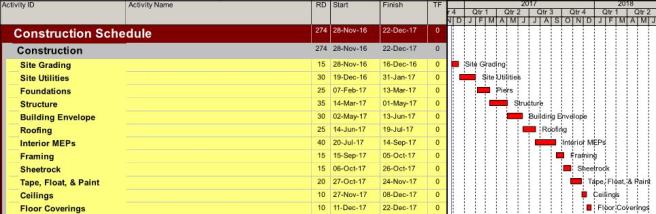
Once you have completed the planning portion of the schedule, the next step is building the schedule structure. Generally, the project superintendent or the individual responsible for the schedule creates a rough layout. This is typically associated with listing and grouping all the tasks necessary to complete the project. I recommend keeping the details at a pretty high level at this point and getting most of the major components identified, then the details can come later. If you are on a very complex project you may be breaking the project up into components or packages by utilizing the Work Breakdown Structure or (WBS). Continue brainstorming and looking through the plans to capture all the major components, such as:
schedule image 1.jpg

Once you have the major components in place, you can begin to add the detail.

schedule image 2.jpg

Then each area can be broken down even further.

schedule image 3.jpg

Once the desired level of detail in the task descriptions is reached, durations can then be assigned to each activity 1d, 5d, 10d etc. Continue down the list until you have added the required durations for each of the activities. At this point you will want to tie each of the activity predecessors to the successors. This links each activity and will create the overall duration; after linking the activities you may find that the overall project length is going beyond the contractual completion date. This can be managed by adjusting the finish to start relationships or the lead/lag of each activity. For example if hanging the sheet rock on the project is going to take 30days, can you start the Tape/Float/Paint task before the end of the 30days? You might also use a Start to Start relationship with a 15 day lag allowing the painter to start 15 days into in the installation of the sheet rock. This will reduce the overall duration of the area by 15 days.

There are a few commonly accepted dependencies in the task sequencing like Finish to Start, Start to Finish, Start to Start and Finish to Finish. It is very important that all activities are tied in some predecessor/successor relationship with the exception of the first and last activity in the construction schedule. It is bad scheduling practice to leave open ended tasks.  Additionally, it is a good idea to place a few milestones into the schedule. A milestone is an activity point of reference identifying key tasks like Topping Out, Building Dry-In, Permanent Power, Conditioned Air, TCO, etc. These project milestones provide a simplified view of the key components in the schedule.

Depending on the project you may be in a situation where at the beginning of the project not all of the information is available to completely detail out the job. For example, you may have detailed foundation/structural drawings but the landscaping package may not have been released. By having conversations with the owner and/or design team you can make assumptions about certain activities, using the activities as placeholders which can be expanded upon as more information comes available. It is very important to include these placeholders and identify them as assumptions with clarifications made in the schedule notes or narrative.

At this point I generally go back and review the schedule to verify that we have all of the individual tasks in the schedule, checking each of the durations, then verifying if they are properly tied to each activity. If your project has trade Superintendents take time to allow them to go through and verify that all of their activities are properly placed and the sequenced.

Once this is complete I generally request that the Project Coordinators go through and add all of the submittal, shop drawing, and material availability dates to the schedule. For example you can’t install the light fixtures if they have not been approved, ordered, manufactured, and delivered. Once this happens for all of the key materials needed on the project they are then individually placed in the schedule and properly tied to the procurement activities as the predecessor. The subsequent installation activity will be the successor your schedule is starts to develop.

Next I request that the Project Manager reviews the schedule checking for accuracy in the contract, design and construction activities along with getting some concurrence on the durations and the sequence of work. They typically review contractual start and completion dates, adjust for any project constraints and the scheduled blackout dates. A conversation needs to be had about the project calendar, if you are planning on working a 5 day work week with the 6th and 7th day being utilized as a makeup day. Also holidays need to be considered if you are not going to work on those days. Consideration should be taken for any owner identified special work restrictions, along with elements that have been identified that cannot be started until other areas are completed because of their being utilized and cannot be taken out of service until the replacement is completed or a temporary one provided.

Through the years I have found it useful to request that each of my subcontractors, both Project Manager’s and Superintendents, review the schedule looking for missing scope, commenting on durations, discussing product availability and providing concurrence the project can be built as currently sequenced and scheduled. Usually this is done in a joint meeting with the General Contractor and each individual sub where comments can be heard, addressed, and make adjustments if necessary. If desired you can resource load your schedule at this point. As an example, if you know how many crews your drywall contractor will be working you may be able to accelerate activities because you have been assured you will have the teams to start concurrent construction activities. Additional thought can be applied to the need to run multiple shifts versus working overtime, along with additional supervision and shift work costs versus the cost of overtime, production lost and safety considerations of working crews extended overtime shifts. Each of these should be considered on long a term project as well as, the cost to employee morale and safety.

You should have a substantial schedule coming together at this point. You may need to make some lead/lag task adjustments, correct any duration’s assumptions, and generally get the schedule to fit within the contractual Start and Finish dates. I would recommend going through this version one last time as a Project Manager and Superintendent to verify you can live with all the assumptions.

It is considered good business practice to incorporate this schedule into each of your subcontractor’s contracts via a change order. This is done at the beginning of the project prior to issuance of contracts to the subcontractor it is typically incorporated in the contract language, if done after the issuance it can be completed via a change order. I generally do this monthly with each new version of the schedule that is issued so each contractor is contractually obligated to the schedule, at this time it may be necessary to review any impacts to the schedule and determine if a sub is responsible for a delay and if acceleration is costs are due to a to maintain pace or can the project manage the delay.

Now a decision needs to be made on updating the schedule. I have found that schedule updates need to be completed every two weeks with the month end schedule update incorporated into each subcontractor’s contract. With each task being reviewed any problems relating to weather, contract issues, design problems, subcontractor delays, materials delivery or NTC’s all get equally entered into the schedule as a frag-net. If this process is completed diligently your schedule will begin to show a history and tell an accurate story of what event occurred on the project. If proper notice letters are written and project updates are entered without bias, the schedule will be a very valuable tool that will benefit the entire project team.

This story will show the good and helps to identify the cause of the bad, allowing you to make informed course corrections along the way.

This may sound like a lot of work, but dedication and detail may be the difference maker that allows you to be successful and the schedule be the accurate predictor of the future of your project.

John Hughes

Project Superintendent